Benazir NSER Program: A Comprehensive Guide to Pakistan’s National Socio-Economic Registry (2026)

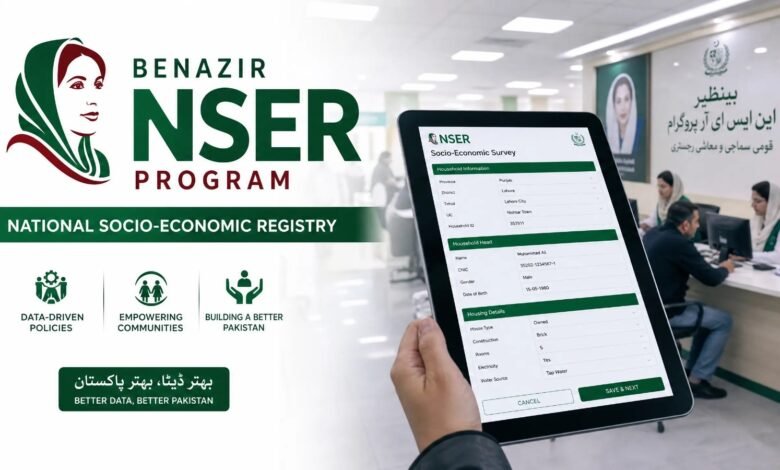
The Benazir National Socio-Economic Registry (NSER) is the backbone of Pakistan’s social safety net, serving as the primary database for identifying and supporting the country’s most vulnerable populations. Established under the Benazir Income Support Programme (BISP), the NSER has evolved into a sophisticated, dynamic system that ensures transparency and accuracy in the distribution of financial assistance.
What is the Benazir NSER Program?
The National Socio-Economic Registry (NSER) is a comprehensive data repository containing detailed information on the socio-economic status of millions of households across Pakistan. Originally launched in 2010-11 through a nationwide door-to-door survey, it uses a Proxy Means Test (PMT) to assign a poverty score to each household. This score determines eligibility for various welfare initiatives, most notably the Benazir Kafaalat Program.
| Feature | Description |
| Governing Body | Benazir Income Support Programme (BISP) |
| Primary Goal | Targeted poverty alleviation and social protection |
| Key Mechanism | Proxy Means Test (PMT) Scoring |
| Current Status | Transitioned to a Dynamic Registry (2023-2026) |
The Evolution: From Static to Dynamic Registry
In its early years, the NSER relied on periodic door-to-door surveys. However, to address the changing economic conditions of families, BISP introduced the Dynamic Registry system. This allows for real-time updates, ensuring that:
- New families can register at any time.
- Existing beneficiaries can update their socio-economic data (e.g., changes in family size, marital status, or income).
- Exclusion errors are minimized by re-evaluating households that were previously ineligible.
See also: Embracing Tomorrow: How Smart Homes are Shaping Modern Living in Malaysia
Key Features of the NSER Dynamic Survey
The modern NSER program is characterized by several user-centric features designed to improve accessibility and reliability:
- Tehsil-Level Registration: BISP has established Dynamic Registration Desks at over 600 Tehsil offices nationwide.
- Digital Data Collection: Data is collected using Android-based tablets, reducing manual errors and speeding up the verification process.
- Integration with NADRA: The registry is linked with the National Database and Registration Authority (NADRA) to verify CNICs and family structures.
- Multi-Program Utility: Beyond BISP, the NSER data is used by over 30 provincial and federal programs, including the Benazir Taleemi Wazaif and various disaster relief initiatives.
How to Register for the Benazir NSER Program
Registration is a straightforward process but requires physical presence for data verification. Follow these steps to participate in the Dynamic Survey:
- Visit the Nearest Office: Locate your local BISP Tehsil Office.
- Provide Documentation: Bring your original CNIC and the B-Forms of your children.
- Interview and Data Entry: A trained official will conduct a brief interview regarding your household assets, education, and living conditions.
- Confirmation: Once the survey is complete, you will receive a confirmation message on your registered mobile number.
Note: There is no fee for the NSER survey. BISP warns citizens against fraudulent agents claiming to charge for registration.
How to Check Your NSER Status (8171 Web Portal)
Beneficiaries can easily check their eligibility and payment status through the official 8171 Web Portal. This transparency ensures that families know exactly when their quarterly installments (currently Rs. 13,500 in 2026) are available.
- Online Check: Visit the 8171 BISP Web Portal, enter your 13-digit CNIC, and view your status instantly.
- SMS Service: Send your CNIC number to 8171 to receive an automated response regarding your eligibility.
Conclusion
The Benazir NSER Program remains a vital instrument for social justice in Pakistan. By transitioning to a dynamic, data-driven model, BISP has ensured that financial aid reaches those who truly need it, adapting to the economic realities of 2026. Whether you are a new applicant or an existing beneficiary, staying updated with your NSER status is the first step toward securing essential social support.